Schlüsselgerät 41Z (SG-41Z)
The planned successor to the Enigma
The history of the Enigma cipher machine and the impact on the Second World War of the Allies cracking its code is well-known. History may well have taken a different course had German plans to replace Enigma actually been implemented. The German High Command had developed a new, more advanced cipher machine – the Schlüsselgerät 41 often known as Hitler’s Mill – but did not succeed in deploying it in any great numbers.
The thwarted gamechanger
Even though the German High Command remained unaware of British success in cracking their code, it knew that the Enigma had weaknesses. Seeking to remedy this situation, German planners commissioned the cryptologist Fritz Menzer to develop a new cipher machine to ensure perfect end-to-end encryption. He began work in 1941 and his new machine was named the Schlüsselgerät 41 or SG-41 for short.
Manufactured by Wanderer-Werke AG, a company located just outside Chemnitz that made bicycles and typewriters, the SG-41 never went into mass production, as shortages of lightweight materials like aluminium meant that it would have been too heavy to be deployed at the front. As a result, the majority of German military communications continued to be encoded by Enigma and thus remained open to Allied intelligence.
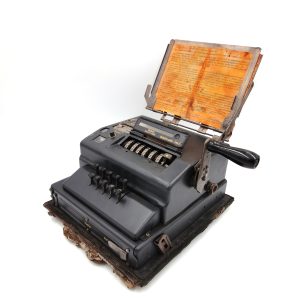
Nevertheless, around 1000 SG-41s were produced, some of which were issued to the Abwehr – German Military Intelligence – in October 1944 to replace the Enigma G. As military protocol specified that Top Secret equipment was to be destroyed or buried before it fell into enemy hands, only a very few examples of this technology remain. It is likely that many more are still buried deep underground.
The SG-41Z was a specialist version of the SG-41, designed to encrypt the Top Secret meteorological information that was of strategic importance to the German air force. Only around 550 examples of this model are thought to have been built, one of which can be viewed in the exhibition of the German Spy Museum.
Ahead of its time: the design of the SG-41Z
The greatest difference between the SG-41Z and the SG-41 was the keyboard. Whilst the SG-41 had a conventional character keyboard with the 26 letters of the alphabet, the SG-41Z featured only ten numeric keys. The two devices were otherwise identical in structure: both were fitted with an operating crank on one side, which led to the machines’ nickname, “Hitler’s Mill”. The mechanical operation of the SG-41Z meant that, unlike the Enigma, it did not require an electricity supply.
The machine was operated by entering the numbers of the message individually, turning the crank to encrypt it after each one. The result was printed on two strips of paper. One showed the letters that had been entered in plaintext, whilst the other recorded the encrypted text. Decrypting the message required its entry on another machine with the same calibration; turning the crank led to issue of the plaintext message.
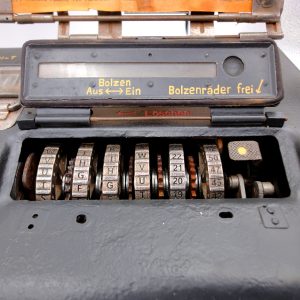
In contrast to purely rotor-based cipher machines such as the Enigma, the SG-41 was a pin-wheel cipher machine based on six encryption rotors into which 144 pins had been inserted to produce what was referred to as an “internal” key. This was augmented by an “external” key resulting from the position of the decoder wheels. As the rotors turned in a randomized process rather than a predictable pattern, the codes produced by the SG-41 were far more difficult to crack than those of Enigma. With a key length of approximately 172 bits on today’s scale, the design and function of the Schlüsselgerät 41 was state-of-the-art in the mid-1940s.
The Allied verdict on the SG-41
Although they were aware of the existence of the SG-41, the Allies never succeeded in understanding its inner workings and managed to decipher only a few messages encrypted by it. Today, experts believe that had the Third Reich been able to deploy the Schlüsselgerät 41 and its SG-41Z variant, Allied cryptanalysts would have had a far more difficult time deciphering German military communications.