Proton underwater scooter
Soviet diver propulsion vehicle
The multifaceted role of modern intelligence services, encompassing both special operations and intelligence gathering, means that they often require special equipment. During the Cold War, the elite Spetsnaz established by the Russian GRU deployed the Proton (протон) diving scooter in combination with the IDA-71 breathing apparatus to move quickly underwater and perform clandestine coastal landings.
The GRU Spetsnaz
The GRU Spetsnaz – the abbreviation for spetsialnogo naznacheniya meaning “troops for special purposes” were founded by the Soviet-era GRU in the 1950s and were continued by the Russian Federation. Trained to perform sabotage, assassinations and intelligence gathering behind enemy lines, little was known in the West about this secret organization until the 1980s, when the GRU officer Vladimir Resun defected. Spetsnaz operations have included the suppression of the Prague Spring in 1968 and missions during the Afghanistan- Soviet War of the 1980s.
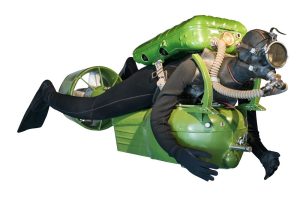
The Proton diving scooter
The Proton on display at the German Spy Museum is a Soviet single-person, battery-powered diver propulsion vehicle (DPV). Developed from a 1960s predecessor model – the Proteus – this second-generation vehicle was first tested in the 1970s and operated in the 1980s alongside another model, the Protei-5.
In a significant improvement on its predecessors, it was possible to adjust the position of the Proton’s propeller. Putting it into the lower of two positions shifted the centre of buoyancy of the entire craft, enabling it to operate just below the water’s surface in such a way that only the diver’s head remained above water. During his journey, the diver was secured by fixed shoulder supports and an adjustable seat and did not need to be strapped to the vehicle.
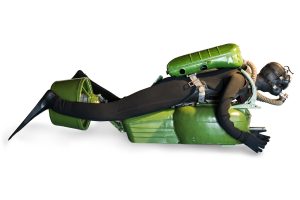
With a maximum speed of 3.5 knots (approximately 6.5 km/h), the Proton had a range of around 24 km, enabling it to be launched from a submarine stationed a little distance from an enemy coastline. Both diver and scooter were released through the torpedo tube; a dangerous undertaking necessitated by the design of Soviet submarines, which lacked any alternative underwater exit. NATO doctrine seeks to minimize this type of deployment for reasons of safety.
IDA-71 rebreather
The Soviet IDA-71 breathing apparatus had been standard Spetsnaz issue since the 1970s. The name IDA refers to the functional designation of the device: izoliruyushchiy dykhatel’nyy apparat, meaning “isolating breathing apparatus”. The number 71 presumably refers to the year in which it was developed.
The design of the IDA7-71 as a closed-circuit rebreather means that unlike conventional diving equipment, it enriches exhaled air with oxygen, enabling its reuse. This prevents the emission of air bubbles that would betray the presence of a diver. It also requires a smaller gas supply than a conventional aqualung, giving the diver the option of staying underwater for longer or carrying a lighter load. The IDA-71 is made of lightweight pressed aluminium and is carried as a backpack containing an oxygen cylinder, a calcium hydroxide container for purifying the exhaled air and a special compartment for underwater communication equipment.